
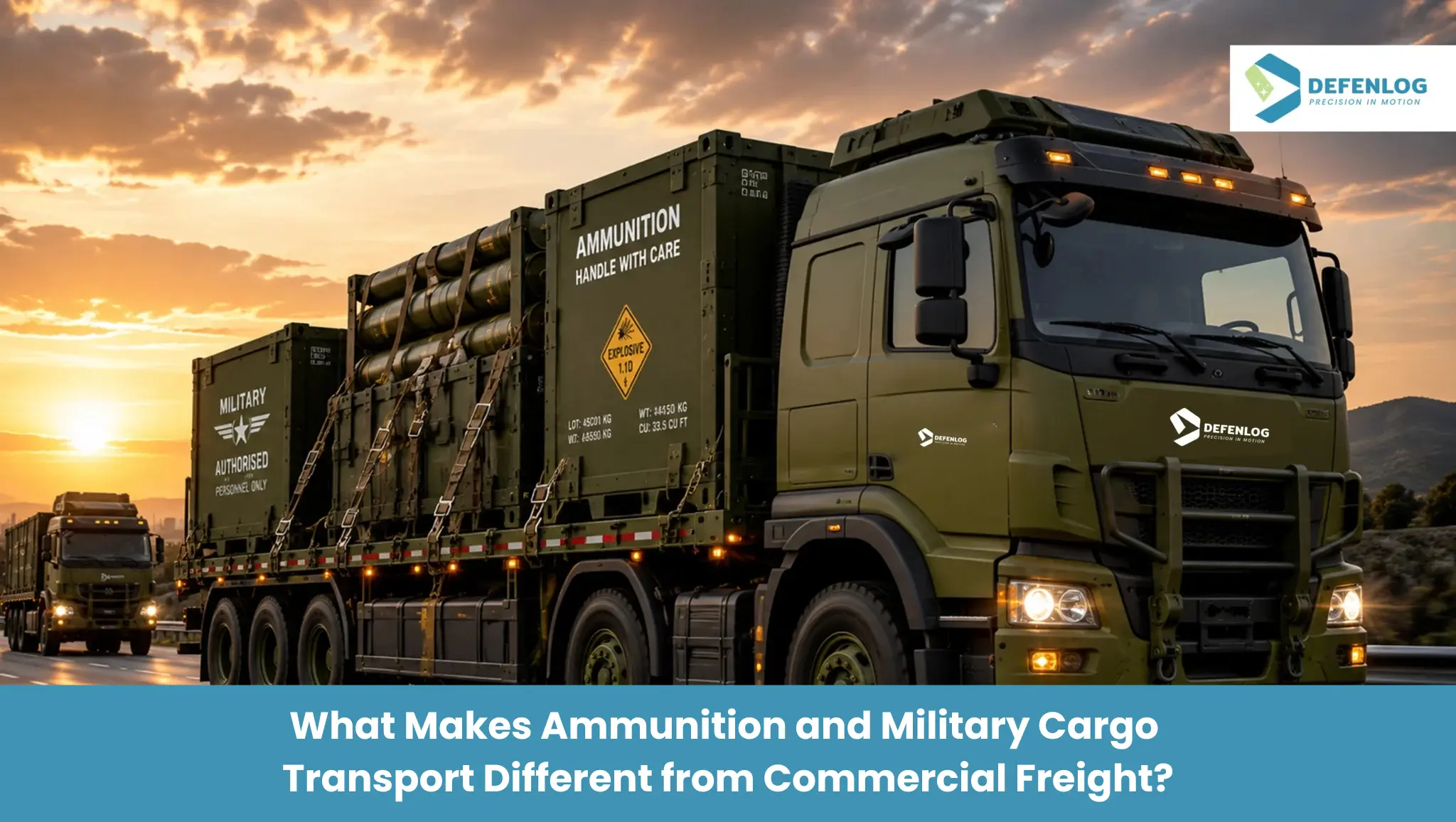
Not all shipments can be classified as ordinary freight. Some cargo necessitates a greater level of control from the moment it is released until it is delivered.
A commercial shipment can often be planned based on price, vehicle availability, and delivery time. Military and explosive cargo are not the same. The real question isn’t just “Can this load move?” The question is, “Can this load move legally, securely, and under complete control?”
For freight forwarders, defense contractors, manufacturers, mining suppliers, and government-linked project teams, this type of transportation is a risk-management choice. A single broken document, unsuitable vehicle, unverified handover, or poor route selection can result in serious safety, legal, security, and reputational issues.
What is Considered Ammunition and Military Cargo?
Military cargo can include many types of goods. Some shipments may be non-hazardous, such as spare parts, protective equipment, communication systems, machinery, tools, or vehicle components. Others may be sensitive, controlled, or dangerous, including ammunition, explosives, pyrotechnic articles, weapon components, and defence-related materials.
This is why military cargo should never be described only as “equipment” or “general cargo” without proper review. Cargo type, classification, packaging, quantity, value, and end use all matter.
Ammunition and explosive articles may be subject to dangerous goods controls. Explosives are classified as Class 1 dangerous goods, while other military-related materials may be classified differently depending on their nature.
Why are Commercial Freight Processes Not Enough?
Commercial freight usually follows standard booking, loading, routing, tracking, and delivery procedures. That approach may work for regular cargo, but it is not enough for ammunition or sensitive military freight.
These movements need stronger oversight because the load may be regulated, valuable, security-sensitive, or hazardous. Military and defence logistics transport often requires closer attention to:
- Legal authorisation
- Vehicle suitability
- Driver training
- Secure loading and handover
- Chain of custody
- Route planning
- Emergency readiness
- Insurance coverage
- Controlled communication
This is where a specialist road transporter is crucial for explosives, Class 1 hazardous cargo, and military & defence logistics. Moving the load is only one aspect of it. It has to do with handling the associated responsibility.
Cargo Classification Comes First
Every safe and compliant transport plan begins with knowing exactly what is being moved. Cargo classification affects vehicle requirements, driver readiness, documents, placarding, packaging, route controls, loading rules, and emergency information.
If the cargo description is incomplete or incorrect, the transport plan can quickly become unreliable. Ammunition, explosives, pyrotechnic materials, and controlled defence cargo may require different handling from standard equipment or spare parts.
Classification can influence:
- UN number and hazard class
- Packaging and labelling
- Vehicle and driver requirements
- Compatibility with other cargo
- Quantity limits
- Emergency response information
- Permits and approvals
- Loading and segregation controls
A strong transport partner will not treat classification as admin. They will use it as the starting point for the entire movement.
Licensing and Authorization are Major Differences
A truck that can transport commercial freight is not automatically suitable for ammunition or military cargo. Depending on the shipment, route, and destination, the operator, vehicle, driver, consignor, and consignee may require specific permits, registrations, approvals, or licenses.
In South Africa, dangerous goods road transport involves responsibilities for consignors, operators, consignees, and drivers. These may include classification, certification, documentation, training, inspections, and incident management. Official controls also apply to the transport, import, export, and movement of regulated goods, including firearms and ammunition.
Before confirming a carrier, businesses should check:
- Is the operator authorized for the cargo type?
- Is the vehicle suitable and licensed where required?
- Is the driver trained and properly documented?
- Are permits and approvals complete?
- Are the consignor and consignee authorized?
- Does the insurance match the cargo risk?
These checks should happen before collection, not when the cargo is already waiting at the loading point.
Security and Chain of Custody Require More Control
Ordinary freight may pass through multiple depots, subcontractors, terminals, and drivers. This may not be suitable for ammunition or military cargo.
A controlled chain of custody helps identify who is responsible for the load at each stage. It should be clear who releases the shipment, who loads it, which vehicle and driver are assigned, who monitors the trip, and who receives the cargo at the destination.
Tracking is useful for sensitive cargo, but it is not enough by itself. The movement also needs controlled access to information, approved handover points, secure communication, and documented delivery confirmation.
Route Planning is About More than Distance
The shortest route is not always the best route. For ammunition and military cargo, route planning must consider safety, security, access, compliance, and delivery timing.
A suitable route may need to account for:
- Road condition and access limits
- Secure stopping areas
- Congested or restricted areas
- Port, mine, depot, or defence-site access
- Delivery windows
- Border points and customs checks
- Escort requirements where applicable
- Emergency support access
For cross-border SADC movements, route planning becomes even more important because country-specific requirements, border delays, and receiving-site readiness can affect the entire shipment.
Documentation Must Match the Actual Cargo
Documentation issues can delay a shipment before it even leaves. Vague cargo descriptions, missing permits, incomplete declarations, or unclear delivery instructions can lead to storage costs, compliance risks, and failed handovers.
Depending on the cargo and route, documents may include:
- Accurate cargo description
- UN number and hazard class, where applicable
- Dangerous goods declaration
- Packaging and quantity details
- Transport permits or approvals
- Emergency response information
- Consignor and consignee details
- Vehicle and driver documents
- Insurance confirmation
- Delivery and handover instructions
- Customs documents for cross-border cargo
For ammunition and military cargo, the paperwork must match the actual load. There is no room for guesswork.
Vehicles, Drivers, and Loading Procedures Matter
The vehicle is only one part of the operation. It must suit the cargo type, route, and security requirements. The driver must also understand the risk, documents, communication process, and emergency procedures.
Before dispatch, businesses should check vehicle condition, load capacity, placarding, cargo restraint, packaging condition, driver training, emergency equipment, and communication plans.
Loading and receiving sites are also important. A secure movement can be weakened if the cargo is loaded in a hurry or if the destination is not ready for controlled handover. Good planning begins with practical questions: who loads, who checks, who signs, who receives, and what happens if timing changes?
Emergency Readiness cannot be Improvised
An incident involving ordinary freight may cause delay, damage, or loss. With ammunition, explosives, or defence-related cargo, the consequences can be far wider.
Emergency readiness must be planned before dispatch. This includes emergency contacts, cargo-specific response information, incident reporting procedures, driver instructions, escalation points, and coordination with appropriate authorities where needed.
A good emergency plan helps protect people, cargo, public roads, the environment, and the businesses involved in the movement.
Insurance Must Cover the Real Risk
Standard goods-in-transit insurance should not be assumed to cover ammunition, explosives, military cargo, or other high-risk freight. Businesses should ensure the policy covers the actual commodity, value, route, loading, temporary stops, cross-border movement, and final delivery.
This is important because the financial consequences of an incident may outweigh the cargo value. It can have an impact on project timelines, customer commitments, production schedules, on-site operations, and contract performance.
Insurance should cover both the cargo risk and the trip distance.
Common Mistakes in Moving Military Cargo
Many problems start before the truck leaves. Common mistakes include:
- Treating military cargo as standard commercial freight
- Using vague cargo descriptions
- Assuming any dangerous goods carrier can move ammunition
- Not checking vehicle or operator licensing
- Starting permit preparation too late
- Ignoring the chain of custody
- Sharing sensitive movement details too widely
- Missing insurance checks
- Using subcontractors without proper verification
- Arriving at secure sites without confirmed access
- Choosing a carrier mainly on price
If the shipment is delayed, rejected, exposed, or non-compliant, even the lowest quote can become expensive.
How to Choose the Right Military Cargo Transport Partner?
The right transport partner should bring more than vehicles. They should bring licensing, planning, discipline, insurance, security awareness, and clear communication.
Before appointing a partner, businesses should consider:
- Experience handling ammunition, explosives, or defence cargo
- Licensed Class 1 transport capability where required
- Suitable vehicles and trained drivers
- Strong compliance knowledge
- Secure route and dispatch planning
- Chain-of-custody control
- Goods-in-transit insurance for high-risk cargo
- 24/7 operational support
- South African and cross-border SADC capability
- Clear communication with shippers, forwarders, and receiving sites
A good partner will ask detailed questions before making promises. That is usually a good sign.
Why Defenlog for Ammunition and Military Cargo Transport?
Defenlog is not a general trucking company. We specialize in specialist road transport, where strict licensing, compliance, insurance, safety, and accountability cannot be left to chance.
Our fleet is authorized to transport explosives and Class 1 cargo. We operate 24/7 and provide comprehensive goods-in-transit insurance for hazardous goods, explosives, high-risk cargo, and all commodities.
We transport military and defence cargo, ammunition, explosives, dangerous goods, project cargo, containerized cargo, and other specialist freight across South Africa and SADC borders.
For freight forwarders, shipping lines, defence contractors, mining companies, and global logistics teams, this means working with a partner that understands the risk before the cargo reaches the road.
Conclusion
Military cargo requires more than transportation capacity.
A truck, driver, and delivery slot are insufficient for ammunition and military cargo. They require accurate classification, authorized movement, secure handling, route control, proper documentation, appropriate insurance, and transparent accountability from release to final handover.
Looking for a specialized road transport partner in South Africa? Defenlog transports ammunition, military cargo, explosives, Class 1 goods, defense equipment, and other regulated freight in a licensed, insured, and safe manner.
Contact us today to discuss your transportation needs.