

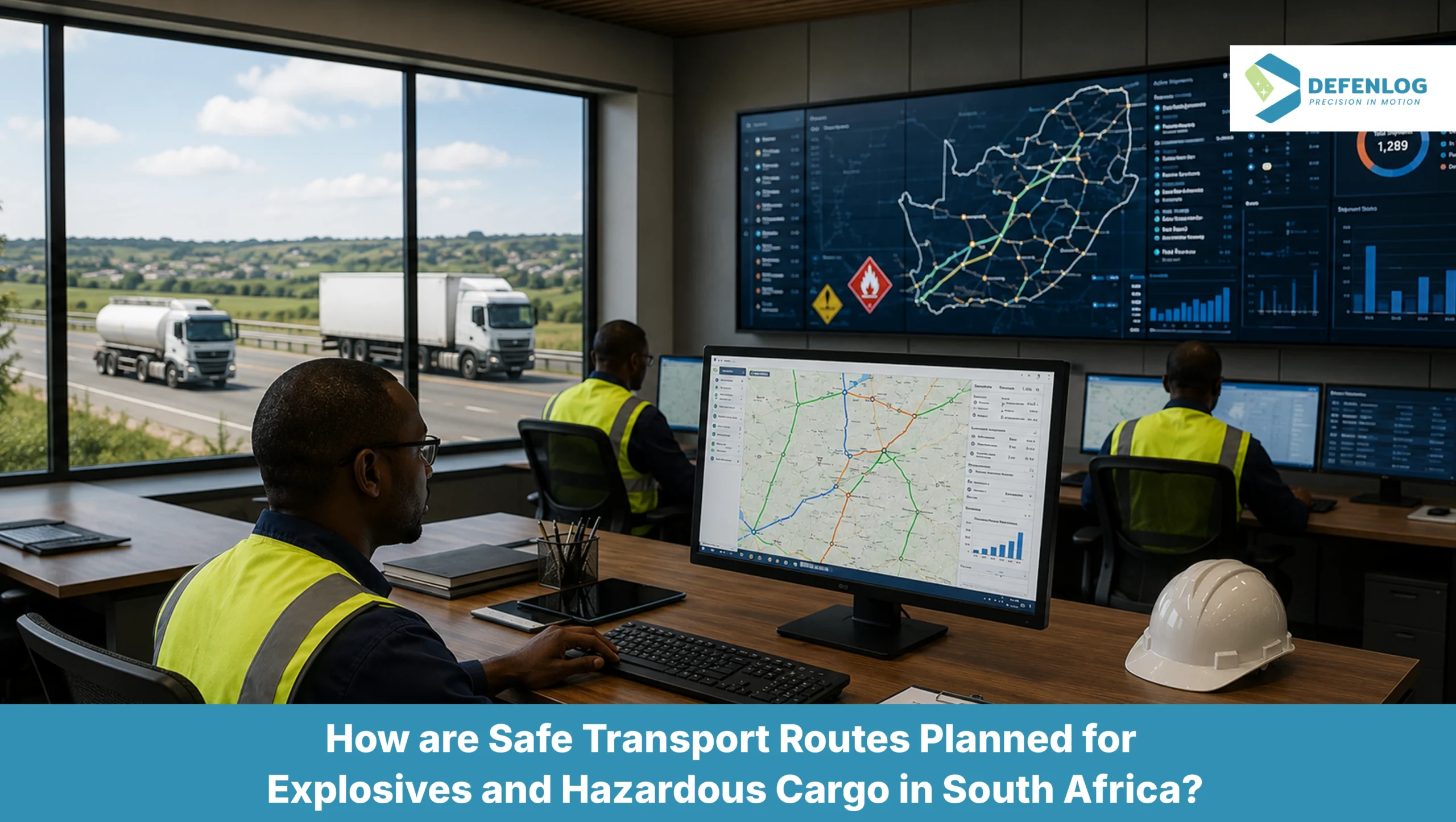
Explosives and hazardous cargo do not simply follow a route.
Every kilometer must be planned around cargo classification, road conditions, public exposure, permit requirements, security risks, and emergency access.
Across South Africa, industries such as mining, manufacturing, energy, and defense depend on the controlled movement of dangerous goods. But unlike standard freight, these shipments leave no room for assumptions. One overlooked road restriction, one unsuitable stopping point, or one unapproved route deviation can delay delivery, create compliance issues, or expose people and the environment to serious risk.
That is why route planning for explosives and hazardous cargo is no longer only about finding the shortest road. It is about risk assessment, regulatory compliance, emergency readiness, and controlled execution from collection to delivery.
The Growing Demand for Explosives and Hazardous Cargo Transport
South African industries move explosives, ammunition, flammable liquids, gases, oxidizing substances, corrosive materials, and industrial chemicals between ports, mines, plants, warehouses, and project sites.
Many travel between provinces, mining regions, and remote industrial areas.
As demand grows, the transporter must understand what the cargo is, where it is going, and which controls are required throughout the journey.
Why Hazardous Cargo Cannot be Treated as Standard Freight?
General freight routes are often selected by comparing distance, fuel use, tolls, traffic, and delivery time.
Those factors still matter, but hazardous cargo introduces additional risks:
- Fire, explosion, leakage, or chemical exposure
- Harm to communities or the environment
- Route and stopping restrictions
- Permit and documentation requirements
- Cargo compatibility concerns
- Theft or unauthorised access
Poor planning can lead to delays, regulatory action, cargo incidents, or operational disruption.
Hazardous cargo transport is not simply collection and delivery. It is a controlled movement from start to finish.
Cargo Classification Comes Before Route Planning
Route planning begins with accurate cargo information.
Before selecting a route, the transport provider should confirm:
- UN number and proper shipping name
- Dangerous goods class
- Explosives division and compatibility group
- Cargo quantity and packaging type
- Net explosive quantity
- Safety Data Sheet
- Emergency-response information
This determines the vehicle, placards, permits, documents, handling process, and route requirements.
Incorrect cargo details can result in the wrong vehicle, unsuitable documents, or an unsafe route. Cargo classification is therefore the foundation of the transport plan.
Vehicle Suitability and Driver Readiness
Explosives and hazardous materials cannot be assigned to any available truck.
The vehicle must suit the cargo class, packaging, weight, and operating conditions. Planning may include:
- Dangerous goods vehicle compliance
- Correct placards and identification
- Suitable load compartments
- Fire and emergency equipment
- Load restraint systems
- Driver qualifications and training
The driver must understand cargo risks, emergency instructions, the approved route, and the communication process.
A compliant vehicle may still be unsuitable if the route includes narrow roads, steep gradients, poor surfaces, restricted access, or delivery-site limitations.
Route Assessment: Identifying Risks Before Dispatch
A navigation system may show the fastest option, but not the safest route for dangerous goods transport.
The transport team may review:
- Road condition, sharp turns, and gradients
- Bridge and vehicle restrictions
- Construction zones and congestion
- Weather exposure
- Communication coverage
- Emergency-service access
- Collection and delivery-site entrances
The route must match the vehicle, cargo type, legal conditions, and operational risks.
Planning these details before dispatch helps reduce delays and prevents the driver from entering unsuitable roads.
Traffic, Stopping Points, and Public Exposure
Busy intersections, peak travel periods, public events, and congested areas may increase the consequences of an incident.
Populated areas cannot always be avoided. The objective is to assess exposure and select the safest practical route.
Planned stops should consider driver rest, inspections, refueling, cargo supervision, security, communication availability, and emergency access.
For explosives and security-sensitive cargo, stopping details should remain controlled and shared only with authorized parties.
Regulatory Compliance and Permit Conditions
Safe route planning must align with South Africa’s dangerous goods and explosives transport requirements.
Depending on the cargo and journey, compliance may involve:
- Dangerous goods documentation
- Explosives transport permits
- Vehicle licensing and certification
- Driver training and professional driving permits
- Operator registration
- Emergency information
- Cross-border approvals
Permit conditions may influence the route, movement time, and required shipment documents.
A route should only be confirmed after the cargo details, driver credentials, vehicle compliance, and permits have been reviewed together.
Emergency Planning and Route Deviations
Even a well-planned movement must prepare for breakdowns, accidents, fire, spills, road closures, severe weather, or security incidents.
Planning should consider fire, police, medical, dangerous goods response, recovery, and communication support.
When the original route becomes unavailable, the driver should not independently choose an alternative.
The transport team should confirm the disruption, assess the alternative road, review security and permit implications, inform the customer and receiving site, and document the approved change.
An unexpected road closure can be managed. An uncontrolled route deviation creates unnecessary risk.
Defenlog: Bringing Control to Hazardous Cargo Transport
Defenlog approaches hazardous cargo transport through structured planning and controlled execution.
Each movement is assessed against its classification, permits, route, vehicle, security, and delivery conditions.
Defenlog’s approach includes:
- Cargo and document assessment
- Route planning and risk evaluation
- Permit and compliance verification
- Suitable vehicle and driver deployment
- Controlled stopping and security planning
- Emergency-response preparation
- Loading and delivery coordination
- Movement monitoring
By combining transport capability with operational discipline, Defenlog supports the controlled road movement of explosives, military cargo, and other hazardous materials across South Africa.
Conclusion: Safe Route Planning Starts Before Dispatch
Explosives and hazardous cargo transport requires more than an available truck and driver.
It depends on correct classification, compliant documentation, route assessment, emergency planning, controlled stops, suitable equipment, and disciplined execution.
For businesses operating in mining, manufacturing, defense, energy, and infrastructure, route planning can directly influence safety, compliance, and operational continuity.
If you are looking for a Trusted Road Transport Partner in South Africa to manage explosives, military cargo, or other regulated materials, Defenlog is ready to support your operation with structured planning and dependable execution.
Contact us today to schedule your explosives and hazardous cargo transport and ensure your shipment moves safely, compliantly, and without compromise.